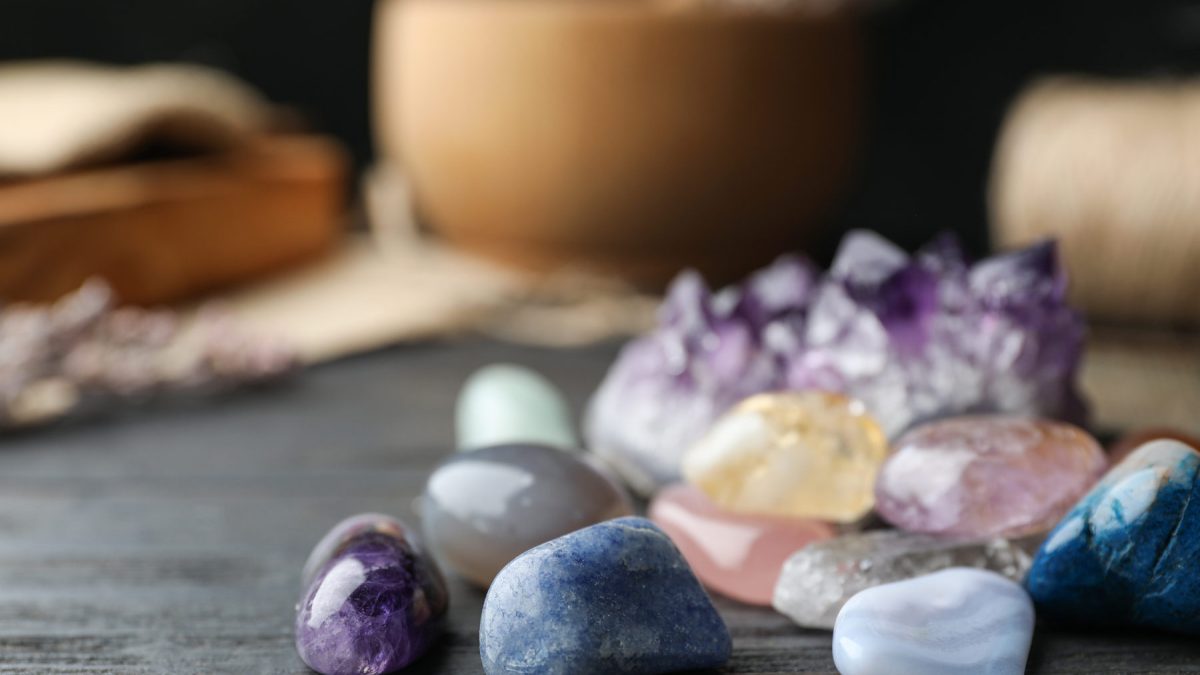
The crystals for protection named most often in crystal traditions are black tourmaline, obsidian, smoky quartz, amethyst, selenite, hematite and labradorite. They are used as anchors for intention and boundary setting, placed at entryways and in busy rooms. There is no scientific evidence that stones block negative energy.
The crystals people reach for first
Ask around and the same seven stones come up: black tourmaline, obsidian, smoky quartz, amethyst, selenite, hematite and labradorite. In crystal traditions these are the stones associated with boundaries, grounding and clearing. They are tools for intention, not shields, and none of them changes anything measurable about a room.
That distinction is worth making early, because it changes how you use them. A stone by your door does not do the work. It reminds you to do the work: to leave the day outside, to notice what you carried in, to decide what belongs in the house and what does not.
What protection means in crystal work
Protection in crystal work means boundary setting, not physical safety. The stones are used to mark a threshold, hold a calmer mood in a busy room, or give a person something to touch when they need to gather themselves. Nothing here replaces a lock, a smoke alarm or professional help when a household needs it.
Seven protection stones and what each is used for
Each stone below carries a traditional association, and where a verified mineral fact exists it is included. Mineral data comes from the Gemological Institute of America and Geology.com. Traditional meanings come from crystal practice and are not scientific findings about the stones.
Black tourmaline
The workhorse of protection stones. Black tourmaline, the variety mineralogists call schorl, is used in the tradition to hold a firm edge at a doorway or a desk. The GIA rates tourmaline at 7 to 7.5 on the Mohs scale, hard enough for daily handling, and notes that it is pyroelectric and piezoelectric, meaning it takes on an electric charge when heated or squeezed. That is a physical curiosity, not an energy claim.
Obsidian
Obsidian is volcanic glass rather than a crystal, which is why it breaks in those smooth curved flakes. In practice it is used for cutting ties and for honesty, the stone people pick when they want to see a situation without softening it. Polished pieces chip, so keep them off hard floors.
Smoky quartz
The grounding stone of the group. Smoky quartz is used when a household feels scattered rather than threatened, and it is a common choice for a home office or a hallway. As a quartz it shares quartz's Mohs 7 durability, so it handles being picked up constantly.
Amethyst
Amethyst is a purple variety of quartz and, according to the GIA, sits at Mohs 7 and takes its name from the Greek amethystos, meaning not drunk, from an old belief that it prevented intoxication. The GIA also notes it was once priced alongside ruby and emerald, until large Brazilian deposits were found in the 19th century. In modern practice it is the calm stone, used in bedrooms and for rest.
Selenite
Selenite is used for clearing rather than blocking, often as a wand or a flat plate that other stones are rested on. It is also the most fragile stone here. Selenite is a variety of gypsum, and Geology.com gives gypsum a Mohs hardness of 2 and notes that this low hardness limits its durability. Keep it dry and handle it gently.
Hematite
Heavy, metallic and cold to the touch, hematite is the stone people use when they want weight. It is associated with steadiness and with returning to your own center after a hard day.
Labradorite
Labradorite is picked for its flash, the blue and green sheen that appears when the stone is turned. In the tradition it is linked with keeping your own counsel and with intuition. Practically, it is a good stone for a shelf where the light moves during the day, because it changes with the light.
A quick-reference table
The table below pairs each stone with its mineral family, its hardness where a source confirms one, the traditional use, a sensible room and a care note. Hardness is left blank where our sources do not state it; assume any unlisted stone needs gentle handling until you have checked it.
| Stone | Mineral family | Mohs hardness (sourced) | Traditional protection use | Suggested room | Care note |
|---|---|---|---|---|---|
| Black tourmaline | Tourmaline (schorl) | 7 to 7.5 (GIA) | Firm boundary at a threshold | Entryway | Durable; dust dry, avoid knocks |
| Obsidian | Volcanic glass | Not stated in our sources | Clear seeing, cutting ties | Living room | Chips easily; keep off hard floors |
| Smoky quartz | Quartz | 7 (quartz, GIA) | Grounding a scattered mood | Home office | Durable; dust dry |
| Amethyst | Quartz (purple variety) | 7 (GIA) | Calm and rest | Bedroom | Keep out of prolonged direct sun as a precaution |
| Selenite | Gypsum | 2 (Geology.com) | Clearing and resetting | Shelf, away from damp | Keep dry; never rinse; very soft |
| Hematite | Iron oxide | Not stated in our sources | Weight and steadiness | Kitchen or desk | Heavy; can mark surfaces |
| Labradorite | Feldspar | Not stated in our sources | Intuition and discretion | Living room shelf | Dust dry; avoid harsh cleaners |
Room-by-room placement for a busy home
Most crystal guides list stones and stop. The useful question in a household with school bags, pets and three people talking at once is where the stones actually go. Placement is a matter of tradition and common sense, and the common sense half is about keeping stones safe and out of the way.
Front door and entryway
This is the first placement in nearly every tradition, and the easiest to keep up. A piece of black tourmaline or obsidian on a shelf near the door marks the threshold. Set it high enough that a toddler or a curious dog cannot reach it, and away from the spot where keys and bags land hard.
Living room
The living room is where a household's noise collects, so it suits a grounding stone rather than a clearing one. Smoky quartz or labradorite on a bookshelf works well. Avoid open bowls of small tumbled stones on coffee tables, which are exactly where small hands find them.
Kitchen
Kitchens are hot, damp and busy, which rules out soft stones entirely. Keep selenite out of this room. A single hematite piece on a windowsill away from the sink and the stove is enough, and it should sit where a pan will never be set down on it.
Bedrooms
Bedrooms are for calm, so amethyst is the traditional choice, usually on a nightstand or a dresser. Keep it out of prolonged direct sunlight as a precaution. If you share a bed, put the stone somewhere both of you can see it rather than on one person's side.
Home office and children's rooms
A desk attracts the scattered-attention problem, which is what smoky quartz is used for; one stone within reach beats a row of them. In a child's room, be conservative: a single piece too large to swallow, on a high shelf, treated as decoration to look at rather than a toy to handle. Never leave loose tumbled stones where a young child or a pet can reach them.
Keeping stones safe around children and pets
Small tumbled stones are a choking hazard for young children and for cats and dogs, and that risk outweighs any placement tradition. Choose large pieces, store loose stones in a closed container rather than an open bowl, and put everything above reach rather than at floor level.
One more rule matters: do not make crystal elixirs by soaking stones in water you intend to drink. Some minerals contain metals or dissolve in water, and there is no reliable way to know what a given piece contains. If you want the ritual of a charged drink, set the glass beside the stone rather than putting the stone in it.
Caring for your crystals
Care comes down to hardness and dryness. Quartz-family stones at Mohs 7, including amethyst and smoky quartz, handle daily handling and a dry dusting without trouble. Selenite at Mohs 2 scratches against almost anything, so it needs its own spot and a soft dry cloth.
- Dust with a dry, soft cloth rather than rinsing, especially for anything soft or porous.
- Keep soft stones out of bathrooms, kitchens and windowsills that collect condensation.
- Store pieces separately so harder stones do not scratch softer ones.
- Keep amethyst out of prolonged direct sunlight as a precaution against color fading.
- Set heavy stones such as hematite on felt or cloth so they do not mark wood.
Cleansing and resetting your stones
Cleansing in crystal practice means resetting a stone's association rather than washing it. The common methods are incense smoke, sound from a bell or singing bowl, a night by a window in moonlight, or holding the stone while you restate what you want it to stand for. Pick a dry method for anything soft.
How often is up to you. A useful rhythm is to reset the entryway stone when something in the household changes: a move, a difficult stretch, a new person in the house. Incense for clearing is one of the items stocked in the Caldwell Psychic shop, alongside intention-setting crystal sets and a single terminated amethyst pointer.
What the research actually says
There is no scientific evidence that crystals block negative energy, and saying so plainly is better for the practice than pretending otherwise. The most-cited study on the question is a 2001 experiment led by psychologist Christopher French, described by TIME, in which 80 people meditated while holding either real quartz or glass imitations.
Both groups reported similar sensations, and people who scored higher on paranormal belief reported stronger effects. The same TIME piece quotes Harvard's Ted Kaptchuk making a point worth keeping: placebo-type benefits are still genuine experiences for the person having them. So use crystals as what they are, and treat any claim about health or physical safety with skepticism.
Pairing stones with other rituals
Crystals sit comfortably alongside other practices, and most people who use them regularly combine two or three. A candle for focus, incense for clearing and a stone for the threshold cover the same ground in different ways, and together they give a household a small routine rather than a single object.
If candle work interests you, our guide to how a psychic candle reading works covers ceromancy, wax shapes and the safety rules that matter with any open flame. Sophie's own psychic candle reading uses honey bee wax candles with sand-scraping crystals for questions about past lives, karmic debts and soulmate ties.
Crystal work at the Caldwell reading room
Crystal Reiki healing at Caldwell Psychic is energy work with crystals aimed at releasing stuck emotional energy, supporting calm and reflection, and deepening connection with your higher self. Sessions start from $150, and session length is arranged when you call. It is offered as spiritual guidance, alongside and never instead of medical care.
If your question is more about the atmosphere you carry than the atmosphere of a room, an aura picture reading and cleansing covers strengths, weaknesses, opportunities and soul ties, then clearing what no longer serves you. You can also read what each aura color is said to mean before you decide, and learn more about Sophie and how she works.
Caldwell Psychic is at 97 Roseland Ave in Caldwell, NJ, open seven days a week including evenings. Call (862) 273-9586 to confirm today's times, or book a crystal session in person, by phone or by video. You must be 18 or older to book.
Frequently asked questions
What are the best crystals for protection?
Crystal traditions name black tourmaline, obsidian, smoky quartz, amethyst, selenite, hematite and labradorite most often. Each carries a slightly different association: tourmaline and obsidian for a firm boundary, smoky quartz for grounding, amethyst for calm, selenite for clearing. Choose the one whose association matches what you want to hold in mind, not the most expensive stone in the shop.
Where should I put protection crystals in my home?
The traditional placements are the front door and entryway first, then wherever the household gathers or argues. A stone by the door marks a threshold, one in the living room sits where the noise is, and one in a bedroom is kept for calm rather than activity. Keep every placement out of reach of children and pets.
Can selenite get wet?
Treat selenite as a dry-only stone. Selenite is a variety of gypsum, which Geology.com lists at a Mohs hardness of 2, one of the softest common minerals, and notes that low hardness limits its durability. Dust it with a dry, soft cloth instead of rinsing it, and keep it off damp bathroom surfaces.
Which crystals are safe around children and pets?
Size matters more than stone type. Small tumbled stones are a choking hazard for young children and for cats and dogs, so keep them well out of reach or choose pieces too large to swallow. Do not make crystal elixirs by soaking stones in drinking water, and store loose stones in a closed container rather than an open bowl.
How do you cleanse protection crystals?
Common methods are smoke from incense, sound from a bell or bowl, a night on a windowsill in moonlight, or simply holding the stone and restating your intention. Choose a dry method for soft stones such as selenite. Cleansing is a ritual of resetting your own attention as much as anything done to the stone.
Do crystals actually work?
There is no scientific evidence that crystals block negative energy. In a 2001 study led by Christopher French, reported by TIME, 80 people meditated with real quartz or glass fakes and described similar sensations, with stronger reports from people higher in paranormal belief. What crystals reliably do is give an intention something physical to attach to.
Can I put black tourmaline by the front door?
Yes, and it is the most common placement in the tradition. The entryway is where a household marks the line between outside and inside, so a stone there works as a reminder every time you pass it. A piece large enough not to be swallowed, set on a shelf rather than the floor, is the practical choice.
Sources
- Tourmaline, Gemological Institute of America
- Amethyst, Gemological Institute of America
- Gypsum, Geology.com
- You Asked: Do Healing Crystals Actually Work?, TIME